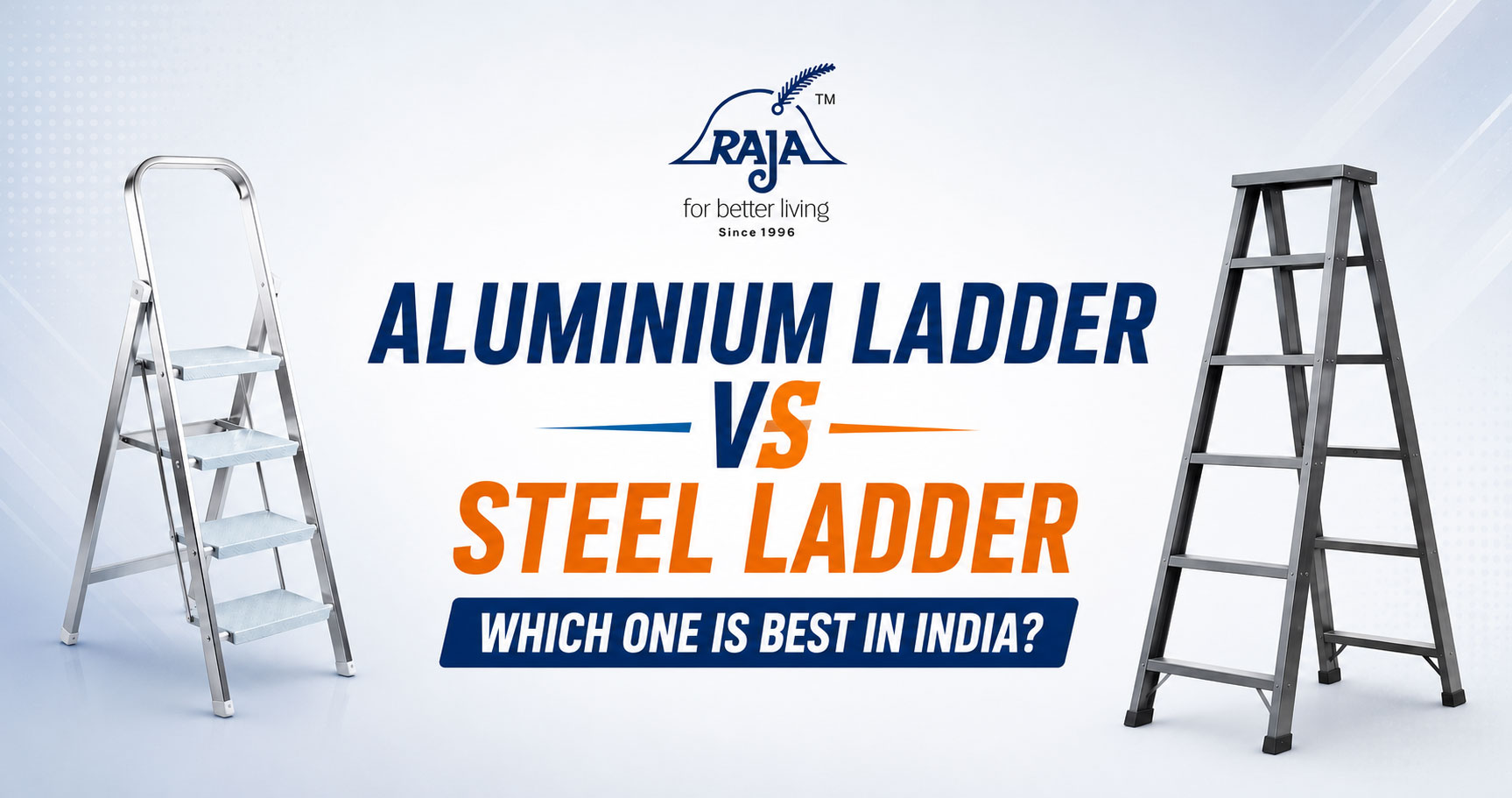
Aluminium Ladder vs Steel Ladder: Which One Is Best in India?

Every household repair, every festive light installation, every cupboard-top storage box you can’t reach…sooner or later, you need a ladder that won’t wobble, rust, or strain your back to carry up two flights of stairs.
The debate between aluminium and steel has been going on in Indian hardware stores for decades, and for good reason: both materials have loyal users. But when you weigh them against each other for how most Indian homes and small businesses actually use ladders, one option tends to come out ahead more often than not.
Weight and Everyday Handling
Steel ladders are the tank of the ladder world — solid, heavy, and built to survive rough industrial use. That weight, though, is exactly what makes them awkward for daily household jobs. Carrying a steel ladder up a narrow staircase, moving it between rooms, or folding it away in a small apartment can turn a five-minute task into a ten-minute wrestling match.
An aluminium ladder, by contrast, is typically a third to half the weight of an equivalent steel model, which matters enormously if the person using it is doing so alone, occasionally, and without help lifting it.
For anyone searching for an aluminium ladder in Ahmedabad for home use: changing bulbs, painting a wall, cleaning ceiling fans – the lighter build is usually the deciding factor before anything else gets considered.
Corrosion Resistance in India’s Climate
This is where the comparison gets genuinely one-sided. Steel, unless it’s heavily galvanised and well maintained, rusts and India’s climate doesn’t do steel any favours. Coastal humidity, monsoon dampness, and long storage in sheds or terraces all accelerate corrosion.
A rusted rung isn’t just unsightly; it’s a safety risk, since corrosion weakens the metal exactly where your full body weight rests. Aluminium naturally forms a thin oxide layer that resists rust almost entirely, so a ladder stored outdoors or used in a humid kitchen or bathroom holds up far longer without flaking or weakening. This single factor is probably why demand for an aluminium ladder in Ahmedabad, a city that sees its share of humid, dusty summers, has grown steadily among households replacing older steel models.
Cost and Long-Term Value
Steel ladders are generally the cheaper option upfront, and if budget is the only concern, that’s a fair reason to consider one. But the equation shifts once you factor in lifespan and upkeep. A steel ladder that needs repainting, rust treatment, or early replacement ends up costing more over several years than an aluminium one that needs almost no maintenance at all.
Aluminium does typically carry a higher initial price tag, but for most households and small commercial users, it tends to work out as the more economical choice over its working life… provided it’s bought once, from a reliable manufacturer, rather than replaced twice.
Safety and Stability
Neither material is inherently unsafe, most ladder accidents come down to poor design, worn feet, or careless use rather than the base metal. That said, steel’s extra weight does give it a lower centre of gravity, which some users find reassuring on uneven ground.
Well-built aluminium ladders close this gap with wider bases, non-slip rubber feet, and locking mechanisms that hold the frame rigid once extended. If anything, aluminium’s lighter weight makes it easier to reposition safely rather than dragging or shoving a heavy steel frame across a floor.
The Bottom Line
Weight, rust resistance, and long-term cost all tend to favour aluminium for typical Indian households and small businesses, while steel remains a niche choice for heavy-duty industrial settings. If you’re comparing options and looking for a dependable aluminium ladder in Ahmedabad, it’s worth choosing a manufacturer that builds for local conditions rather than a generic import.
Explore Raja Interiors‘ range of aluminium ladders, built for Indian homes and built to last.